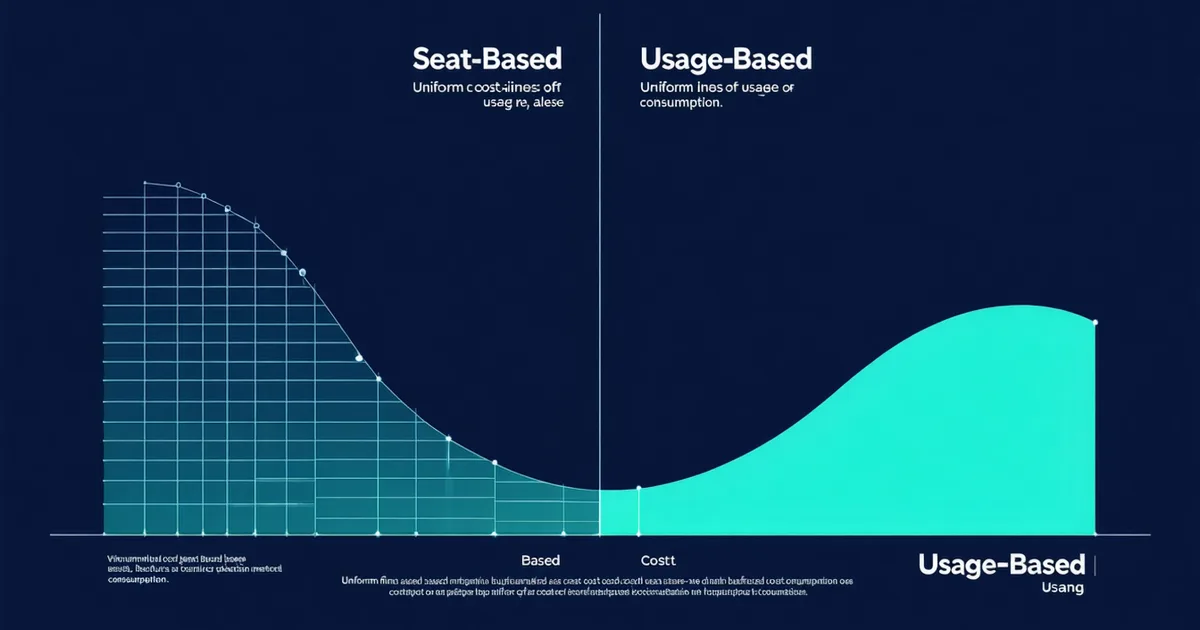
Seat-based pricing has a long, successful track record in SaaS. It's easy to forecast, easy to explain in a sales motion, and easy to invoice. A company with 50 engineers buying a developer tool at $20/seat/month generates $1,000 MRR — no aggregation logic required. For a certain class of product, it's still the right answer in 2025.
But usage-based billing has moved from a niche curiosity to the dominant model for a growing cohort of infrastructure, API, and AI-native products. The shift isn't ideological. It follows the underlying economics of the product being sold. Understanding which model fits — and why the math changes — is the first decision any pricing-aware team should make before touching a billing system.
When Usage-Based Beats Seat-Based
The case for usage-based billing is strongest when three conditions hold simultaneously: value delivery is tightly correlated with consumption volume, marginal costs scale with usage, and buyers want risk alignment before committing to capacity.
Consider an API-based natural language processing service used by a growing media platform. They might have three engineers who each have accounts, but their actual usage is 40 million document classifications per month in peak editorial cycles and nearly zero in off-peak periods. A seat-based model charges the same flat rate regardless of this variance. A usage-based model aligns the vendor's revenue with the customer's actual value received. The customer sees this as fairer; the vendor captures revenue proportional to platform engagement.
This matters even more for AI inference products where your marginal cost per request is real and non-trivial. If your GPU compute costs scale linearly with requests, a flat-rate seat model creates dangerous economics at scale: low-usage customers are profitable, high-usage customers erode your margin. Usage-based pricing inverts this — it's structurally sound against the cost curve.
We're not saying seat-based pricing is wrong for API products. We're saying that when the usage distribution across your customer base is high-variance, seat-based pricing creates both revenue leakage (from high-usage accounts paying a capped flat rate) and churn risk (from low-usage accounts who feel overcharged for capacity they didn't use).
The Hybrid Model: When You Need Both
Pure consumption billing has its own failure modes. For enterprise buyers, variable invoices are hard to budget for and hard to get through procurement. Finance teams want predictability. The hybrid approach — a committed minimum plus consumption overage — threads this needle.
A typical hybrid contract looks like this: a customer commits to $5,000/month minimum, which covers up to 10 million API calls. Usage beyond that threshold is billed at a discounted overage rate — say $0.40 per additional thousand calls, versus the standard $0.60 for pay-as-you-go. The customer gets budget predictability and a volume discount. The vendor gets a revenue floor and retained upside as the customer grows.
For products that have both a user-level access component (e.g., a dashboard that RevOps analysts log into daily) and a consumption component (API calls or data processed), a compound model is often appropriate: per-seat for the human-facing access layer, per-unit for the machine-generated consumption. Many data pipeline and analytics tools operate this way — a per-seat charge for the BI interface, a per-query or per-row charge for the compute backend.
The implementation complexity here is real. You need a metering system that tracks usage at the customer level with enough granularity to correctly apply the threshold logic, prorate mid-cycle changes, and surface the numbers on an invoice that a CFO can audit. Home-built billing systems often handle the happy path but break on the edge cases: plan upgrades mid-billing-period, credits applied against minimum commitments, overage invoices that need to reference the base contract.
Unit Economics Math for AI-Native Products
Let's work through a concrete unit economics comparison for an AI writing tool. The product generates long-form text via LLM inference. The vendor's cost structure: roughly $0.008 per 1,000 output tokens (blended model cost including infrastructure amortization).
Scenario A — per-seat pricing at $50/user/month. Customer has 20 content writers. Monthly revenue: $1,000. If average usage is 2 million output tokens per user per month = 40 million total tokens. At $0.008/1K tokens, COGS is $320. Gross margin: 68%. But one power user generates 8 million tokens alone — costing $64 in compute against their $50 seat fee. That user is underwater on margin. The product is subsidizing its heaviest users.
Scenario B — usage-based at $0.015 per 1,000 tokens. Same 40 million total tokens → $600 revenue. That feels like a revenue reduction, but the margin structure is consistent: 47% gross margin on every customer regardless of usage intensity. The heavy user who generated 8 million tokens pays $120, which covers their $64 COGS with room. Low-usage accounts pay proportionally less — reducing churn from customers who would otherwise feel they're paying for capacity they're not using.
The crossover point where seat-based becomes more profitable is when usage distribution is narrow and predictable — most users consume similar volumes. Collaboration tools and project management software fit this profile. Usage-based wins when the distribution is wide and you want the revenue-to-cost relationship to remain stable as the product scales.
Making the Transition
Moving from seat-based to usage-based isn't a pricing decision alone — it's an infrastructure project. You need instrumentation before you can bill. Every billable event needs to be captured, deduplicated, aggregated across time windows, and made available for invoice generation before the end of the billing period.
The practical checklist before going live with consumption billing: instrument every billable action in your product, implement an event ingestion pipeline with idempotency so retries don't cause double-counting, set up customer-level aggregation with configurable time windows, build a metered usage display so customers can track their consumption in real time (this alone reduces dispute frequency dramatically), and test proration logic for mid-cycle plan changes before you have paying customers.
Existing customers are a negotiation, not a diktat. If you're migrating a seat-based customer to usage-based, grandfather their current monthly spend as a minimum commitment and let their actual usage determine whether they land above or below that floor. This gives them the predictability of the old model while aligning incentives over time. Most customers will grow into the new model naturally if the pricing signal matches the value they receive.
The companies that get this wrong don't fail because of the pricing model itself — they fail because their metering infrastructure isn't reliable enough to be the basis of a customer invoice. An inaccurate usage count isn't an inconvenience; it's a trust event. Every billing dispute traces back to an event that was counted twice, a time window that was applied incorrectly, or a plan change whose proration math was wrong. The infrastructure is the pricing strategy.
Choosing Your Path
If your product has more than two of the following characteristics, usage-based billing is likely the right base model: variable consumption across your customer base, marginal cost that scales with usage, enterprise buyers who want committed minimums with overage upside, competitors in your space already doing consumption billing, or an AI/API/infrastructure layer where you're the infrastructure behind someone else's product.
If your product is primarily human-facing, has relatively uniform usage across accounts, and your buyer has a strong preference for predictable budgets without engineering complexity, seat-based remains defensible and often preferable. A per-seat model for a 500-person sales team using a CRM-adjacent tool is still the industry-standard answer — the cognitive overhead of tracking per-activity consumption outweighs any alignment benefit.
The hybrid model earns its complexity when you have an enterprise buyer who needs budget predictability and a product where high-consumption customers represent your best expansion opportunity. The committed-minimum structure is essentially a land-and-expand pricing mechanism built into the contract itself.
Whichever model you choose, build the metering layer first and get confident in its accuracy before you attach an invoice to it. Customers forgive aggressive pricing; they don't forgive inaccurate invoices.