Enterprise buyers of software infrastructure products have a genuine problem with pure consumption billing: their finance teams need to book software expenses against an approved budget, and an invoice that varies by 40% month to month is hard to budget for. The procurement team wants a number they can put in a PO. The CFO wants a commitment they can amortize. Pure pay-as-you-go doesn't fit neatly into enterprise financial operations.
The annual contract with usage overages resolves this tension without forcing the vendor to give up the revenue upside of consumption growth. A committed minimum gives the buyer their predictable cost floor. An overage rate that activates above the commitment gives the vendor proportional revenue as the customer grows. When structured correctly, this model aligns incentives in a way that both sides will renew.
Committed Minimum Mechanics
The committed minimum is the contractually guaranteed annual spend, invoiced either upfront (common for enterprise buyers with annual budget cycles) or in monthly installments. The minimum defines an event volume threshold included in the base commitment; overage begins when consumption exceeds that threshold.
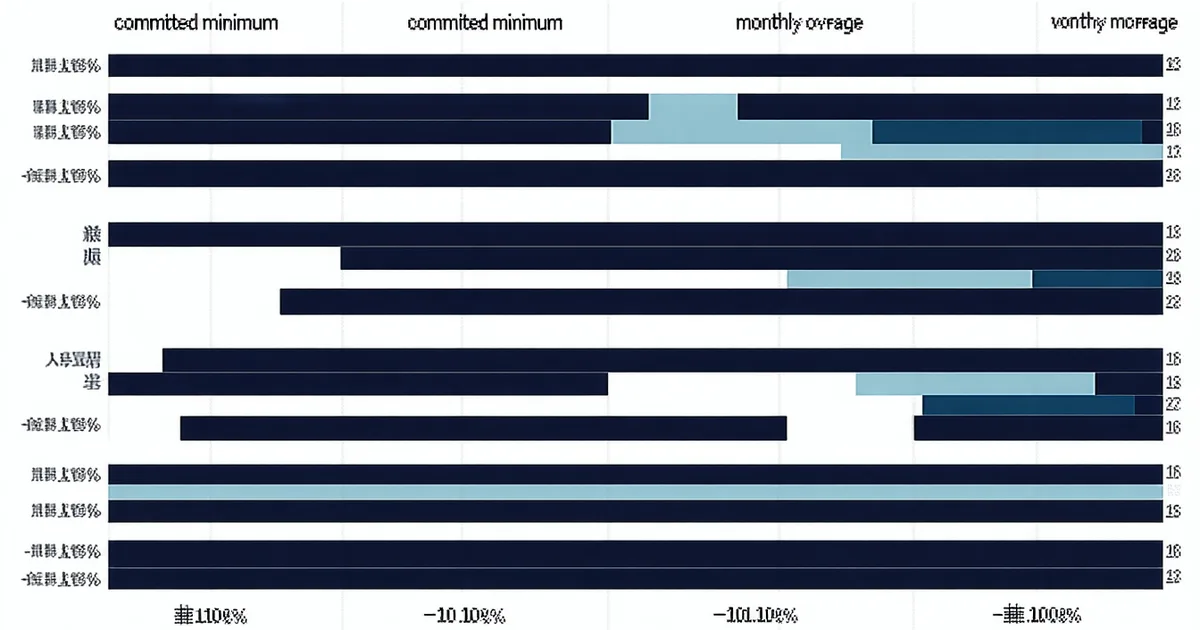
There are two ways to structure what "minimum" means in the context of monthly billing within an annual contract. The first is a monthly minimum commitment: the customer owes the committed amount each month regardless of usage, and overage is calculated monthly against that month's threshold. The second is an annual pool: the customer commits to a total annual spend, can draw down against that pool each month based on actual usage, and only triggers overage when the annualized rate exceeds the committed total.
The monthly commitment structure is simpler to implement and explain. The annual pool structure is more buyer-friendly — a month with lower usage doesn't result in "wasted" commitment spend, because the pool carries forward. Enterprise buyers with seasonal usage patterns strongly prefer the pool model. The implementation complexity is higher: you need to track cumulative pool consumption across the contract period, correctly calculate when the pool is exhausted, and handle mid-year renewals or expansions that adjust the remaining pool balance.
A concrete example: a B2B analytics platform with a growing media customer signs an annual contract. The committed minimum is $30,000 over 12 months, which covers 50 million API events per year (approximately 4.17 million/month). The overage rate is $0.55 per 1,000 events above the pool. The customer processes an average of 6 million events per month — at months 8-9, their cumulative event count crosses the 50 million pool threshold. Overage billing begins for the remaining months of the contract. At renewal, they negotiate a higher commitment tier based on their demonstrated usage.
Overage Billing Logic
The overage calculation must be precise and verifiable. If a customer's finance team cannot independently calculate their overage charge from their usage data, you will get disputes. The invoice line item for overage must show:
- Committed pool size (total events included in commitment)
- Events consumed to date (cumulative since contract start)
- Overage events this period (current period consumption beyond the pool)
- Overage rate (price per 1,000 events)
- Overage charge (overage events × rate)
When overage begins mid-period (i.e., the pool is exhausted partway through a billing month), the overage charge should be calculated only for the events that occurred after pool exhaustion, not for the entire month. This requires your metering system to accurately timestamp events and your billing engine to identify the exact event that crossed the pool threshold — down to the event count, not just the billing period.
Overage rates in enterprise contracts are typically lower than the equivalent standard pay-as-you-go rate (often 10-20% lower) as a reward for the commitment. This discount should be stated explicitly in the contract and reflected in the invoice. "Overage at $0.55/1K events (vs standard $0.65/1K)" — this line item makes the discount visible to the buyer's finance team and reinforces the value of the committed structure.
Proration on Annual Plans
Annual contracts create specific proration scenarios that don't arise in monthly billing. If a customer starts mid-month, should their first billing period be a partial month, or should you align to calendar month boundaries from the start? If a customer upgrades their committed minimum mid-contract, how do you handle the remaining pool versus the new pool?
For annual contracts, the standard practice is to align all billing periods to the contract anniversary date, not calendar months. A contract that starts October 15 has billing periods from October 15 to November 14, November 15 to December 14, and so on. The first period may be prorated if the contract is signed after the period start date is agreed upon.
Mid-contract commitment upgrades are a revenue expansion event worth handling well. The correct approach: calculate the remaining pool under the original commitment, add the incremental pool from the upgraded commitment, and calculate a prorated incremental charge for the additional commitment for the remainder of the contract term. The invoice for a mid-contract upgrade should show both the original commitment (partially consumed) and the incremental commitment (new, starting from upgrade date).
We're not saying every edge case needs to be handled at contract signing. We're saying that if your billing system can't represent a mid-contract upgrade without manual intervention — if your finance team has to hand-calculate the prorated amount and enter it as a one-off adjustment — then your billing infrastructure isn't enterprise-ready, regardless of what your sales pitch says.
The Enterprise Negotiation Reality
Enterprise buyers use commitment negotiations as a pricing discovery mechanism. When you quote a committed minimum with an overage rate, the buyer will counter. Understanding what levers exist and which ones you can move makes the negotiation cleaner for both sides.
Levers you can move without undermining the economics: committed pool size (higher commitment = larger included volume), overage rate discount (higher commitment = steeper overage discount), payment terms (upfront vs quarterly vs monthly installments), and contract length (24-month contract may justify a better overage rate than 12 months).
Levers that signal weakness if moved without reason: the base overage rate for low-commitment customers (if enterprise customers can negotiate your standard overage rate down, it creates internal pricing inconsistency), and the grace period for pool exhaustion (extending the grace period before overage kicks in erodes the whole model).
The billing system's role in enterprise sales is underappreciated. A sales engineer who can pull up a real-time simulation showing "if your usage follows your historical growth rate, here's when your committed pool exhausts and here's the projected annual cost under three different commitment tiers" closes contracts faster and at higher commitment levels than one who has to send a spreadsheet 48 hours later. The metered usage data that your billing infrastructure captures isn't just for invoicing — it's sales collateral for renewal and expansion conversations.
The strongest argument for annual-commitment-plus-overage is that it's genuinely good for both parties. The buyer gets a predictable budget line with the flexibility to grow. The vendor gets a revenue floor plus proportional upside. The model fails only when the committed minimum is set so low that overage is frequent from month one (erodes the predictability value) or so high that the customer regularly under-consumes (erodes the alignment value). Getting the commitment sizing right at contract start — based on real historical usage data, not optimistic projections — is the most important factor in whether this model works long-term.