Failed payments are not primarily a technical problem. They're a customer relationship problem that has a technical dimension. A subscription payment fails for one of several reasons: the card was expired, the card was declined (insufficient funds or a bank hold), the payment method was canceled, or a temporary network or processor error occurred. The distribution of these failure reasons matters enormously for how you design a dunning system.
Transient failures — temporary bank holds, processor timeouts, network errors — often resolve on the next retry without any customer action. Card expiration and genuine hard declines require customer action. The dunning systems that recover the most revenue distinguish between these categories and apply appropriate strategies to each rather than treating all failed payments identically.
Dunning Sequence Design
A dunning sequence is the series of retry attempts and customer notifications that follow an initial payment failure, culminating either in successful collection or in subscription cancellation. The sequence design determines how aggressive your recovery effort is and how much disruption it creates for customers in the process.
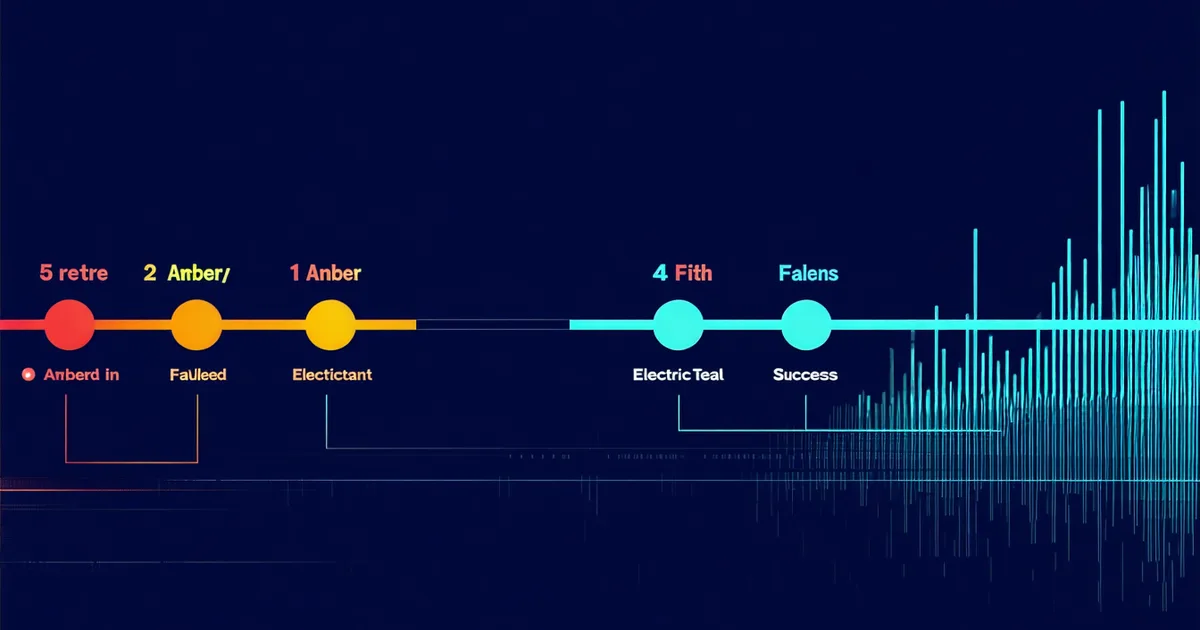
The structure of an effective dunning sequence for a monthly-billed SaaS:
- Day 0: Initial payment failure. Immediate retry for transient failure codes (network error, processor timeout). No customer notification for the first attempt — no point alerting customers about errors they don't need to take action on.
- Day 1: If Day 0 retry failed, send a soft notification email: "We had trouble processing your payment — we'll try again in a few days. No action needed." This email reduces anxiety without demanding immediate action.
- Day 4: Second retry attempt. For card expiration failures specifically, this retry should be preceded by a card update request email sent on Day 2 or 3, giving the customer time to update before the retry fires.
- Day 7: Third retry. At this point, send a firmer notification: "Your payment has failed twice. Please update your payment method to avoid service interruption." Include a direct link to the payment update page — requiring navigation to the billing settings page adds friction that reduces completion rates.
- Day 14: Final retry. Last notification: "Your account will be suspended [date] unless payment is received." The suspension date should be stated explicitly, not implied.
- Day 15+: Account suspension or downgrade (not deletion). The customer's data is preserved for a grace period (typically 30-60 days) to allow recovery.
Industry-observed recovery rates for dunning sequences that include smart retry timing and customer communication typically fall in the 15-25% range for initial failed payments — meaning that 15-25% of customers who experienced an initial payment failure ultimately pay successfully through the dunning process. The range is wide because it varies significantly by payment method mix, customer type, and how well the dunning sequence is tuned.
Retry Timing: Card Network Intelligence
Not all retry timing is equal. Card networks return decline codes that carry information about why a charge failed. A soft decline (code insufficient_funds) suggests retrying at a different time in the month when the customer may have a lower balance. A hard decline (code do_not_honor or lost_card) means retrying will not succeed and you should move directly to the customer communication phase.
Smart retry logic for soft declines considers:
- Day of week effects: Charges attempted on weekdays, particularly Tuesday-Thursday, have modestly higher success rates than weekend charges for many B2B customers, likely correlated with business expense processing patterns.
- Time of month: Retrying around the 1st-5th of the following month captures customers whose accounts may have been funded by the previous month's end-of-month payroll cycle.
- Decline code mapping: Maintain a mapping from decline codes to retry vs no-retry vs notify-customer classifications. This prevents wasted retry attempts on hard declines and reduces unnecessary card network inquiry costs.
We're not saying you need a machine learning model for retry timing. We're saying a simple decision table based on decline codes, combined with a retry schedule that avoids weekends for B2B customers, captures most of the available recovery without building a complex system.
Customer Communication During Dunning
The tone of dunning communications determines whether a customer who has a failed payment becomes a churned customer or a recovered customer. Dunning emails that read as automated debt-collection notices create friction and embarrassment. Dunning emails that read as helpful reminders from a product the customer values create an opportunity for recovery.
Key principles for dunning communication tone:
Blame the bank, not the customer. "We weren't able to process your payment — this sometimes happens when cards expire or billing information changes" is more effective than "Your payment failed. Update your card immediately." The first acknowledges that payment failures are often not the customer's fault. The second is accusatory and creates defensiveness.
Make the action path frictionless. Every dunning email should include a single, prominent link that takes the customer directly to the payment update flow, not to a general account settings page. The fewer clicks between "email received" and "payment method updated," the higher the recovery rate.
Segment by customer history. A customer who has been paying reliably for 18 months deserves a more charitable tone than a customer whose payment has failed every other month. Long-tenure customers with a first-time failure often have a simple explanation (card reissued after expiry). Treating them the same as chronic payment failures is both wrong and counterproductive for retention.
For enterprise customers on annual contracts, dunning by email is often insufficient and sometimes inappropriate. A failed charge on a $50,000 annual contract warrants a direct call from the account manager, not an automated email. Your dunning system should route high-value account payment failures to the sales team for personal outreach rather than through the standard automated sequence.
Grace Period Logic and Account State
The grace period — the time between payment failure and service termination — is a critical variable that most billing systems treat as a fixed constant. A better approach is to vary grace period length based on customer value and tenure.
A 3-day grace period for a customer on a $49/month plan who signed up two weeks ago is reasonable. A 3-day grace period for a customer on a $500/month enterprise plan who has been paying for three years is relationship damage. High-value customers should receive longer grace periods and more direct outreach before service is affected.
Grace period state in your billing system must be precise: the exact timestamp at which the grace period ends should be stored and used for enforcement, not a fuzzy daily job that checks "is it past the grace end date." If a customer updates their payment method at 11:58 PM on day 14 of a 14-day grace period, their service should not be suspended. Your grace period enforcement needs to check against minute-level timestamps, not date comparisons.
Account suspension and data deletion are two different states that should be separated by a second grace period — typically 30-90 days. Customers who pay outstanding invoices during the suspension period should be able to restore their account and access their data without losing any history. Permanent deletion should require explicit confirmation and be irreversible — it's not a dunning enforcement action, it's a final data cleanup step.
The most expensive dunning failure isn't a failed payment that doesn't recover — it's a high-value customer who churns because the dunning experience was humiliating or the grace period was too short for them to resolve an administrative issue on their end. Calibrate your dunning system not just for revenue recovery, but for the customer relationship you want to preserve after the payment issue is resolved.